Toilet Repair Dublin
A toilet only gets noticed when it stops working. Whether yours runs all night, leaks onto the floor, won't flush or rocks when you sit down, our toilet repair service in Dublin can usually sort it in one visit.
We repair every common type, from standard close-coupled toilets to wall-hung pans with concealed cisterns and old high-level cisterns in period houses. When a repair no longer makes sense, we also supply and fit replacement toilets.
We work in homes, rental properties, apartment blocks, pubs, hotels, offices and industrial sites across Dublin, and in Leixlip, Maynooth and Celbridge in Co. Kildare.
Signs Your Toilet Needs a Repair
Most toilet faults give plenty of warning. Book a visit if you notice any of the following:
- a faint hiss or trickle long after the last flush
- water running down the back of the bowl in a thin stream
- the cistern refilling by itself every few minutes
- buttons that stick, or a handle that needs jiggling
- puddles or damp flooring around the base
- a flush that needs two or three goes to clear the bowl
- movement when anyone sits down
Any one of these is a reason to book a repair before it turns into a bigger job.
Fixing these early is cheaper and quicker than waiting for a failure. A running cistern, for instance, can waste thousands of litres a month, which matters in homes on a water meter and in any business. For more tips on saving water, see the leaks advice from Uisce Éireann.
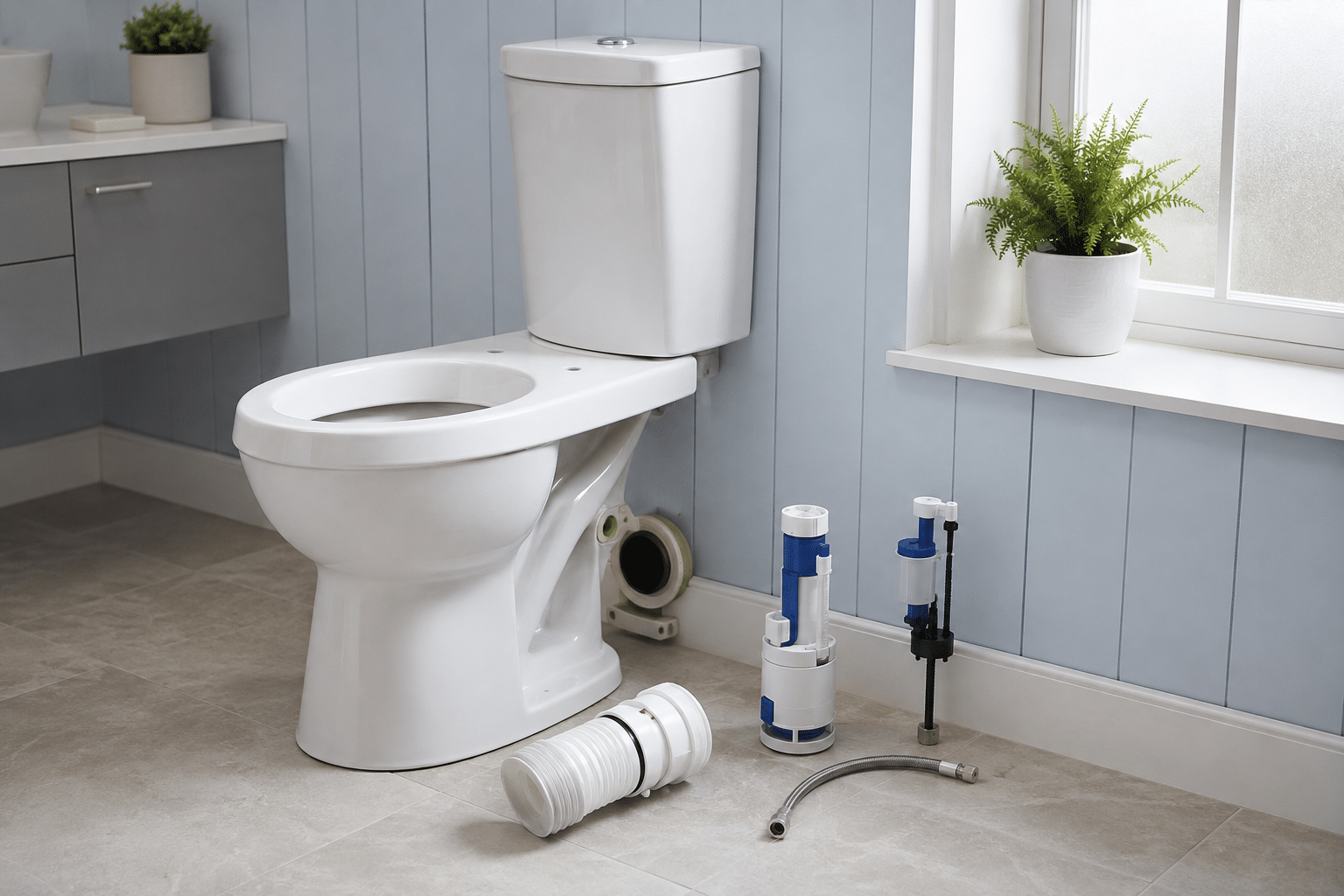
How a Toilet Works
Knowing the main parts makes it easier to describe a fault on the phone, and it helps you understand what we're fixing.
The inlet valve lets water into the cistern and closes when the float rises to the right level.
The flush mechanism releases the stored water into the pan. Modern toilets use a drop valve with a rubber seal, while older ones use a siphon with a flexible diaphragm.
The overflow carries excess water into the pan or outside if the inlet valve fails to close.
The pan and connector carry the flush into the soil pipe. A flexible connector seals the joint between the two.
The isolation valve on the supply pipe lets you turn off water to the toilet alone. Every toilet should have one, and we fit one if it's missing.
When we repair a toilet, the fault almost always lies in one of these five areas. Consequently, we can usually pinpoint it within a few minutes.
Toilet Running Constantly
A toilet that never stops running is the most frequent job we see. The cause is either water coming in when it shouldn't, or water leaking out through the flush.
We find out which one it is by watching the cistern empty and refill. That way, we only replace the part that has actually failed, rather than swapping the whole mechanism by default.
A worn flush seal usually needs a new washer or a complete drop valve. A faulty inlet valve may just need cleaning or adjusting, although older valves are often worth replacing outright.
Both repairs normally take under an hour. Afterwards, we set the water level correctly, so the cistern fills fully without spilling into the overflow. This is the most common toilet repair our customers book, and it pays for itself quickly.
In the meantime, turning the isolation valve off between uses stops the waste. Just remember to turn it back on before the next flush.
Toilet Not Flushing Properly
A weak or failed flush has several possible causes, and it pays to check them in order.
- Low water level in the cistern, often from a badly adjusted or partly blocked inlet valve.
- A broken button or cable, especially on push-button and concealed systems.
- Split siphon diaphragms on older lever-operated cisterns.
- A partial blockage in the pan or the pipe just beyond it.
- An isolation valve left half shut after previous work.
On busy family toilets, the flush button takes a battering, so a replacement button is one of the cheapest repairs we do.
If the cistern is full but nothing happens when you press the button, the problem lies in the flush mechanism. If the cistern is empty or half full, the supply side is at fault.
Telling us which of these you see saves time, because we can bring the right parts for the repair.
Push buttons on modern cisterns often use a small cable or plastic rod. When that snaps, the button feels loose and nothing happens. It's a cheap part and a quick fix.
Toilet Leaking at the Base or Cistern
Water on the floor around a toilet always needs checking, since it can soak into floorboards and ceilings below.
Leaks at a toilet usually come from one of four places:
- A failed pan connector, when water appears at the back of the pan straight after a flush
- Worn cistern bolts or the large seal between cistern and pan, when drips come from underneath
- A tired flexi hose or isolation valve, when water gathers around the supply pipe
- Condensation, when the cistern sweats in a cold bathroom even without a leak
Each of these has a straightforward fix. We replace the failed seal, connector or hose, then test with several flushes. Where a floor has been wet for a while, we'll also tell you if the boards feel soft, so you can get them checked.
In apartments, a toilet repair often starts with a complaint from downstairs. If a neighbour reports a stain on their ceiling below your bathroom, turn off the toilet's isolation valve and call us to trace the source.
Slow-Filling or Noisy Cisterns
A cistern that takes ages to refill, or whistles and bangs while it fills, usually points to the inlet valve.
Older ball valves wear out and start to chatter. Modern valves can clog with grit or scale, particularly after mains work in the street. In many cases, cleaning the small filter solves the problem. In others, a new valve is the better option.
Low pressure can cause slow filling too. For example, an isolation valve left half closed, or a pump that's struggling, starves the cistern of water. If we find a wider pressure issue, we'll explain it and check the supply before replacing parts.
We fit valves that suit your pressure: high-pressure valves on mains-fed cisterns, and low-pressure versions where the supply comes from an attic tank. That detail makes a real difference to how quickly and quietly the cistern refills.
Noisy pipes when a cistern fills can also point to loose clips or high pressure. We check both as part of the toilet repair, because fixing only the valve may leave the banging in place.
Concealed Cistern and Wall-Hung Toilet Repair
Wall-hung toilets and concealed cisterns look tidy, but their workings sit behind the wall. As a result, owners often assume a repair means breaking tiles. Usually, it doesn't.
Wall-hung pans also rely on the frame bolts to carry their weight. If the pan feels loose, stop using it and book a repair, because a loose pan can crack or break its seal.
Most concealed frames allow access through the flush plate opening. Once we remove the plate, we can reach the inlet valve and flush valve, and replace them without disturbing tiles or panels.
Parts vary between manufacturers and frame generations, so a photo of your flush plate is extremely useful. It helps us identify the system and bring the correct components.
Where a concealed cistern sits behind a removable panel or inside furniture, access is even simpler. On the other hand, a cistern fully tiled in with no service opening is harder, and we'll talk through the options before starting. We work on these systems regularly in apartments and newer homes.
Close-Coupled, Back-to-Wall and Old High-Level Toilets
Close-coupled toilets, where the cistern sits directly on the pan, are the most common type and the simplest to repair.
Back-to-wall and shrouded toilets hide the pipework behind a unit or a moulded cover. Access is tighter, so we check how the unit comes apart before we start.
High-level cisterns, with a pull chain and a long flush pipe, still appear in some Victorian and Edwardian houses in Dublin 4, 6 and 8. Parts for these are harder to find. However, many can be kept working with a new siphon, float or valve. Owners who want to keep the period look can usually do so.
Low-level cisterns connect to the pan with a short pipe, and the joints on that pipe are a common leak point.
Whatever the style, every toilet repair starts with identifying the type, because that determines which parts fit.
If you're renovating a period bathroom, we can also advise on reconditioned or reproduction cisterns that keep the traditional look with modern internals.
Blocked Toilets
A blocked toilet is one of the most unpleasant household problems, and in a single-bathroom home it's urgent.
Many people ask us whether a blockage needs a plumber at all. If the water level drops slowly after a flush, you can often clear it yourself.
Before you call, try a proper toilet plunger, not a sink plunger, with slow, firm strokes. Don't keep flushing, because that only raises the water level. Avoid chemical cleaners too, as they can damage seals and make our job harder.
We clear blockages in the pan and in the pipe close to the toilet. Wet wipes, sanitary products, cotton buds and too much paper cause most of them. Even wipes labelled as flushable can snag and build up over time.
If the blockage turns out to sit further along the pipework, beyond the toilet itself, we'll tell you straight away and explain the next step.
For businesses, a simple sign asking staff and customers not to flush wipes can prevent repeat call-outs.
A blocked toilet is often the first problem families call us about after moving into an older house, because the previous owners' habits have left build-up in the pipework.
When to Replace Instead of Repair
Most toilets can be repaired for many years. Still, replacement makes more sense when:
- the pan or cistern is cracked, even slightly
- parts for the model are no longer made
- the toilet has needed several repairs in a short time
- the flush uses far more water than modern dual-flush designs
- you're updating the bathroom anyway
When choosing a new toilet, a few measurements matter. First, the outlet position, known as a P-trap or S-trap, must match your soil pipe. Second, the distance from the wall to the outlet decides which pans fit. Third, the space in front affects comfort, especially in small bathrooms.
We can supply a suitable toilet for you, or fit one you've already bought. If you're buying it yourself, send us the product link first, and we'll confirm it suits your pipework.
Features worth considering include a dual flush to save water, a soft-close seat, a rimless pan that's easier to clean and a comfort-height pan for older users.
What Happens During a Toilet Replacement
- Isolate: the water goes off, and the cistern and pan are emptied.
- Remove: we disconnect the supply and lift out the old toilet.
- Prepare: the soil pipe and floor fixings get checked and cleaned.
- Position: the new pan goes in with a fresh connector and secure fixings.
- Connect: cistern, supply and water level are set up.
- Finish: a neat seal goes around the base, followed by repeated test flushes.
A straightforward swap usually takes two to three hours. Longer jobs include moving the outlet, changing a wall-hung frame or adapting old pipework.
Before we leave, we check every joint for leaks and make sure the seat is secure. We also leave the area clean. If a new isolation valve is needed, we fit it at the same time.
Planned replacements during weekday office hours cost less, so for anything that isn't urgent, it's worth booking ahead.
Replacing a toilet in an apartment or upstairs bathroom follows the same steps. The only difference is extra care with the floor seal, since a leak there affects the ceiling below.
Toilet Repair Dublin for Homes, Landlords and Apartments
Homes. Most calls come from households with a running cistern, a faulty flush or a leak at the base. In a house with one toilet, we treat a failure as urgent.
Landlords and letting agents. Toilet problems are among the most common tenant complaints. We arrange access with the tenant, fix the fault and send you confirmation once the job is done.
Apartment blocks. A leaking toilet in an upper unit can soon affect the apartment below. Management companies can call us for individual units or for common-area toilets in gyms, staff rooms and other shared areas.
For landlords with several properties, we can check toilets and valves during a single planned visit. That kind of preventive work avoids many emergency calls later.
Commercial Toilet Repair in Dublin
A hotel corridor, a busy bar or a forecourt shop puts far more strain on its toilets than any household. The same goes for restaurants and B&Bs. Buttons wear out, valves fail sooner and blockages happen more often.
Offices, gyms and shops face the same issues on a smaller scale. Meanwhile, factories and warehouses need working welfare facilities to keep staff on site and meet their obligations.
We can repair toilets before opening, after closing or during quieter periods, so customers aren't disturbed. Where several toilets use the same mechanism, we can also advise on replacing worn parts across the building at once.
For hospitality venues, a failed toilet on a Friday night is a real problem. We can attend in the evening, so the facilities are working again before the next busy day.
Invoices for companies can be paid by transfer, card or cash. Just give us the business name when you book.
Saniflo and Macerator Toilets
A Saniflo unit lets you put a toilet where there's no direct soil pipe, such as in a basement, attic conversion or under the stairs. It grinds and pumps waste through a small-bore pipe.
Fitting new Saniflo units and freeing blocked ones are both part of our work. Blockages usually come from wipes, sanitary items or too much paper. Signs include a pump that runs constantly, a humming noise without flushing, or water that drains very slowly.
We don't repair the internal motor or electronics. When a unit has failed internally, a replacement is normally the most reliable fix, and we can fit it for you.
To protect a Saniflo, only paper and human waste should go down it. A small notice beside the toilet helps guests and tenants remember.
If a Saniflo stops working completely and it's the only toilet, it counts as urgent. Turn off its power, avoid using it and call us the same day.
Toilet Repair Dublin FAQs
How long does a toilet repair take?
Most repairs, such as a new flush valve, inlet valve or pan connector, take under an hour. A full toilet replacement usually takes two to three hours.
Can you repair my toilet today?
Often, yes. We carry common parts for most toilets. For unusual concealed systems or old models, we may need to order a part, and we'll tell you when you call.
Is it worth repairing an old toilet?
Usually, yes, if the pan and cistern aren't cracked and parts are available. A repair costs far less than a replacement.
Do you supply new toilets?
Yes. We can supply a suitable toilet, or fit one you've bought yourself once we've confirmed it suits your pipework.
More Questions About Toilets
Why does my toilet refill by itself?
Water is escaping from the cistern into the pan, usually through a worn flush seal. The inlet valve then tops the cistern back up.
Can I still use the toilet while it's leaking?
If the leak is at the base, avoid using it and turn off the isolation valve behind the toilet. Then call us to book a repair.
Do you work on urinals?
Yes. We replace urinals and clear blocked ones.
Are you insured?
Yes. We're fully insured, and we leave the bathroom clean when the job is done.
Book a Toilet Repair in Dublin
Cost varies with the time of the visit: a weekday daytime slot is the cheapest, and out-of-hours, weekend or holiday call-outs are charged more. You'll receive our hourly rate as a message on your phone or by email, and the van leaves only after you've said yes.
At the end of the job, domestic customers settle up by cash or card, or by a texted payment link. Firms can use a bank transfer instead.
For a quicker job, send a photo of the toilet, the flush button and any visible leak. For an urgent problem, just ring. Outside Dublin, we also carry out toilet repairs and replacements in Leixlip, Maynooth and Celbridge. You'll find more on our plumbing services and 24 hour plumber pages, while the areas we serve are listed on a separate page.