Storage Water Tank Cleaning Dublin
Lift the lid on an attic tank that nobody has opened in years and you'll often find a layer of silt, rust flakes, dead insects or bits of old insulation. Our water tank cleaning service in Dublin empties the tank, removes that build-up and puts the system back into use, clean and working properly.
Most tank cleaning is planned work rather than an emergency. That means we can agree a time that suits you, usually during office hours, when our rates are lowest.
We clean cold water storage tanks in houses, flats, rental properties, B&Bs, offices and other commercial premises. Our area covers Dublin, plus Leixlip, Maynooth and Celbridge over the border in Co. Kildare.
What Your Cold Water Storage Tank Does
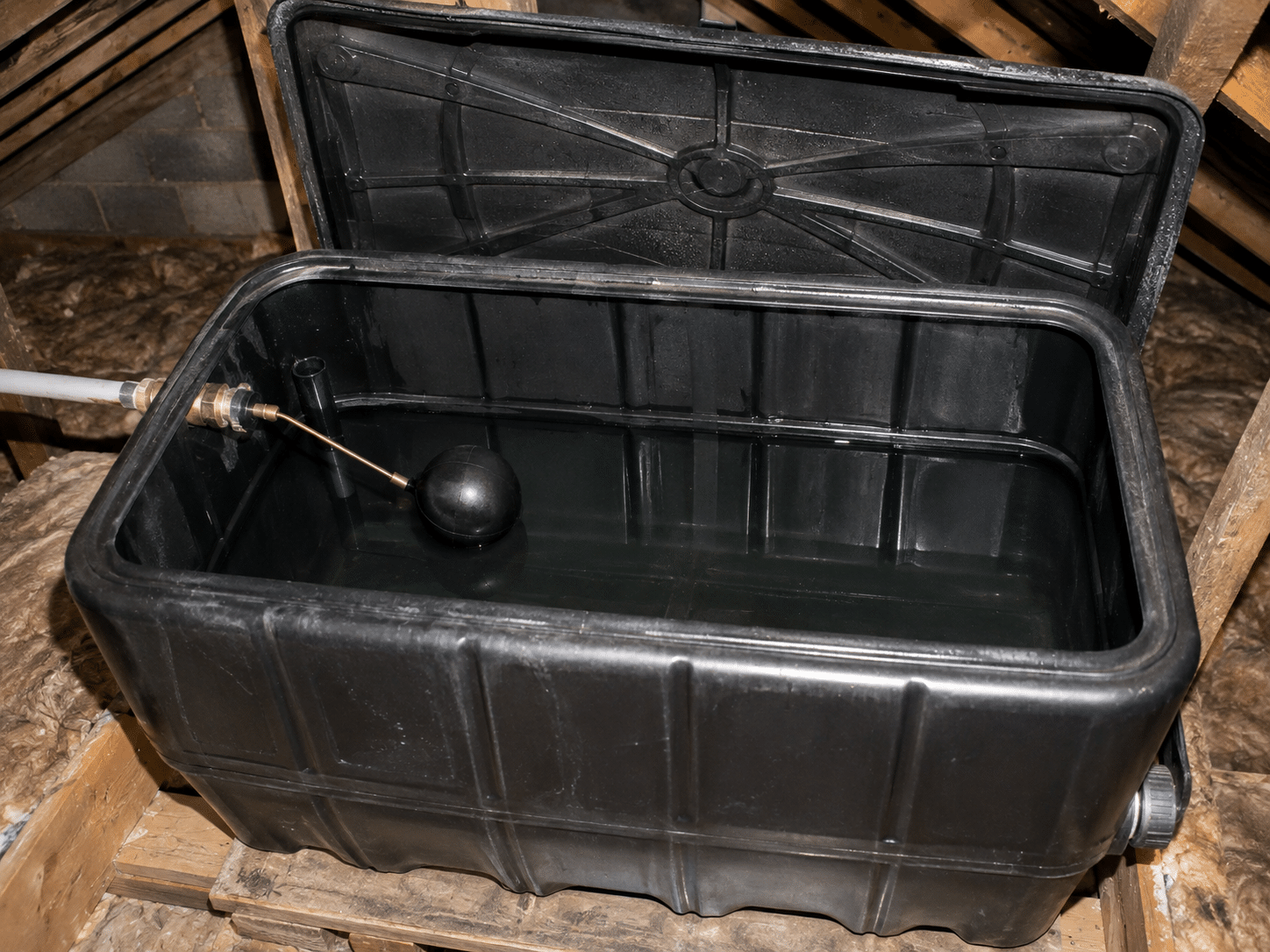
In many Irish homes, a cold water storage tank sits in the attic and supplies most of the house by gravity. Typically, it feeds the toilets, the bath and basin taps, and the hot press.
The kitchen cold tap, on the other hand, usually runs straight from the mains. For that reason, it's the tap people normally drink from.
Because the tank holds still water for long periods, anything that gets in tends to stay there. Dust, debris and sediment settle on the base, and over the years they can build into a thick layer.
A missing or badly fitting lid makes this much worse. Insects, leaves and loose insulation fall straight in, and the dirt then travels through the pipes to your taps and toilet valves.
Regular cleaning keeps that material out of the system and gives us a chance to check the tank itself.
Older houses benefit most, since their tanks may have sat untouched for decades. In those homes, a clean often removes far more sediment than the owners expect.
Signs Your Water Tank Needs Cleaning
You don't need to wait for a problem before booking a clean. Still, these signs suggest the tank deserves attention soon:
- cloudy, brown or gritty water from the bath or basin taps
- small particles collecting in tap aerators or shower heads
- a musty or unusual smell from the cold taps upstairs
- toilet cisterns that fill slowly or keep running
- a lid that is cracked, missing or doesn't fit
- no record of the tank ever being cleaned
- a recent move into an older house
Sediment carried down from the tank often causes slow-filling cisterns and blocked aerators. Cleaning the tank removes the source, though we may also need to clear the affected valve or aerator.
If the water looks unusual at the kitchen tap as well, the cause may lie in the mains supply. In that case, contact Uisce Éireann too.
How Water Tank Cleaning Works
Every tank is different, but the job normally follows these steps:
- Check the access: we look at the hatch, the ladder, the route across the attic and the space around the tank.
- Isolate the supply: we close the valve that feeds the tank, so no fresh water enters while we work.
- Empty the tank: all the stored water has to come out, through the outlets and then by hand from below the outlet level.
- Remove the sediment: we lift out the silt and debris from the base without letting it run into the pipes.
- Clean the surfaces: we clean the walls, base and underside of the lid by hand.
- Refill and flush: finally, we refill the tank and run the outlets until the water runs clear.
Before we leave, we check the float valve, the overflow and the connections again. After that, we tidy the attic and the landing below the hatch.
Why Emptying the Tank Takes Time
A clean is only as good as the emptying that comes before it. Every drop of stored water has to go, and on a full tank that takes a while.
Most of the water leaves through the outlet pipes to the taps and hot press. However, the outlets sit slightly above the base, so the last few centimetres stay behind. That remaining water is where most of the sediment collects, so we remove it by hand, together with the dirt.
Larger tanks naturally take longer. Similarly, narrow outlet pipes or a house with only one bath tap slow things down.
We plan our time around this, rather than rushing the job. As a result, the sediment comes out of the tank instead of being washed into your pipework.
Once you know the tank size and the access, we can give you a realistic idea of how long the clean will take.
Disinfecting the Tank After Cleaning
Disinfection is a separate stage from cleaning. Chemicals can't break down a layer of sludge, so the physical clean always comes first.
Where the tank and pipework suit it, we can disinfect the tank once it's clean. We leave the solution for the required contact time, then flush it through the outlets until none remains.
Not every system needs this step, and in some older installations it isn't appropriate. So we'll tell you on the day whether we recommend it and why.
Keep in mind that water from a storage tank isn't drinking water, even after a clean. For drinking and cooking, use the kitchen tap on the mains supply.
If you have questions about the quality of the public water supply in your area, Uisce Éireann is the right place to ask.
Attic Access for Water Tank Cleaning
Access affects the job more than anything else. A tank beside a proper attic ladder, on boarded joists with a light, is simple to reach. By contrast, a tank at the far end of an unfloored roof space, boxed in by timber or buried in insulation, takes considerably longer.
Before booking, please tell us:
- whether there's a fixed attic ladder or we need to bring one
- how far the tank is from the hatch
- whether the route is boarded or open joists
- if the tank is boxed in or covered with insulation
- whether there's a light in the attic
Photos of the hatch, the route and the tank help most of all. With them, we can judge the work before we travel and give you a realistic estimate.
We only work where access is safe. If the tank can't be reached safely, we'll explain what needs to change first.
What Affects the Cost of Tank Cleaning
There's no single price for tank cleaning, because no two tanks are alike. The main factors are:
- Access: the biggest factor, as explained above.
- Tank size: a larger tank holds more water and more sediment.
- Location: travel distance and parking near the property.
- Day and time: office hours cost least, while evenings, weekends and bank holidays cost more.
- Condition: heavy sludge or a very old tank adds time.
Since tank cleaning is rarely urgent, most customers choose an office-hours slot. That way, they pay the lowest rate.
Once we have the details and photos, you'll get our hourly rate and an estimate in writing by WhatsApp, text or email, and we only set off once you've seen it. You simply reply to accept.
Using Water While We Clean the Tank
While the tank is empty, anything it feeds won't work. Usually, that includes the toilets, the bath and basin taps and the hot water.
The kitchen cold tap normally stays on, because it runs from the mains. It's still worth filling a kettle and a few bottles before we start, just in case.
We plan every clean so that you're without these outlets for as short a time as possible.
Please switch off the immersion before we arrive and avoid running the hot taps.
We also flush each toilet once before starting, then leave the cisterns alone until the tank is full again.
As soon as the tank is back in service, we run each outlet to clear any air and cloudy water. Everything should then work normally again. A short burst of air from the taps or a little cloudiness in the first minutes is normal and soon settles.
Lids, Float Valves and Overflows
A clean tank won't stay clean for long without a good lid. So, if yours is cracked, loose or missing, we'll recommend a close-fitting replacement with a screened vent. That keeps insects and dust out while still letting air in.
In fact, a new lid is one of the simplest and most useful upgrades after a tank clean.
While the tank is empty, we check the float valve that controls the incoming water. A worn valve may let the tank overfill, or it may stop it filling properly.
We also look at the overflow pipe. Water running from an overflow outside the house often means the float valve needs attention.
Small fixes like these are ordinary plumbing work, and we carry common parts in the van. For larger jobs, we'll explain what's needed and agree it with you before doing anything more.
A tank that is actively overflowing or leaking into a ceiling is a different matter. For that, call our 24/7 emergency plumber line straight away.
Older Galvanised and Asbestos Cement Tanks
Some older Dublin houses still have galvanised steel tanks. Over time, these rust from the inside, and cleaning can reveal thin or pitted metal. If we find that, we'll show you and discuss replacing it with a modern plastic tank.
Whether a replacement is practical depends mainly on access. In a house, the new tank has to fit through the hatch and across the attic, so we check the route before recommending it.
A few properties built before the 1980s still have tanks made from asbestos cement. They are usually grey, heavy and slightly rough in texture. We don't clean, cut or disturb these tanks. Instead, the material needs a specialist asbestos survey first.
If you're not sure what your tank is made of, a clear photo usually tells us. That's one more reason to send pictures before the visit.
Knowing the material in advance also shapes the plan for your clean, from the tools we bring to the time we allow.
Plastic tanks are the most common today. Although they don't rust, they can still crack or bow if the support underneath is weak, so we check the platform too.
Water Tank Cleaning Dublin for Landlords and Property Managers
For landlords, a clean tank means fewer complaints about dirty water and fewer call-outs for sticking valves. Many add tank cleaning to their regular maintenance, particularly when a property changes tenants.
We can arrange access with your tenant directly, as long as you've given permission. Please let them know the water will be off for part of the visit.
After the clean, we send you a short summary with photos of the tank before and after. It also notes anything we spotted, such as a damaged lid or a worn float valve.
Property management companies looking after several units can book tanks in batches. As a result, we can organise the visits efficiently, and each property gets its own record.
Domestic customers and landlords pay by cash or card on site once the work is done, or by payment link.
Commercial Water Tank Cleaning in Dublin
Businesses rely on their water supply every day, so tank cleaning needs careful planning. We clean storage tanks for B&Bs, pubs, restaurants, cafés, offices and other premises.
Commercial tanks are often larger, and some sit in plant rooms or on roofs rather than in an attic. Therefore, we ask for photos and details of the tank, the access and any site rules before confirming the work.
To limit disruption, we can schedule the clean for a quieter time of day. For example, a B&B might choose late morning, once guests have checked out.
Some businesses also keep maintenance records for their premises. Our report and photos from each clean fit neatly into those records.
For payment, businesses can choose a bank transfer, a card or cash. We carry full insurance and tidy up the plant room or attic before leaving.
We also replace storage water tanks, mostly on commercial premises, where plant rooms and roofs usually give easier access than a domestic attic. After inspecting the old tank, we'll tell you whether a clean is still worthwhile or a new tank makes more sense.
For other plumbing work on commercial premises, see our full list of plumbing services.
Areas We Cover for Tank Cleaning
We clean storage tanks throughout South Dublin, including Dún Laoghaire, as well as in the city centre and West Dublin, including Lucan and Adamstown.
Beyond Dublin, we also serve Leixlip, Maynooth and Celbridge in Co. Kildare.
When you get in touch, please include the Eircode. It lets us confirm the area and include travel in the price.
Because tank cleaning is planned in advance, we can also group nearby jobs and keep travel costs down.
You'll find more about our coverage on the Emergency Plumber Dublin page.
If your tank problem turns out to be a leak rather than dirt, our burst and leaking pipe repairs page explains how we deal with it.
Equally, if low pressure upstairs is the real issue, a booster pump may be the answer.
Water Tank Cleaning FAQs
How often should a water tank be cleaned?
There's no fixed rule. Many homes benefit from an inspection every few years, and a clean whenever sediment has built up or the lid gets damaged.
How long does water tank cleaning take?
It depends on the tank size, how much sediment there is and the access. Emptying the tank fully takes some time, so we'll give you an estimate once we've seen photos.
Will I have water during the clean?
The kitchen cold tap usually stays on, as it runs from the mains. Toilets, bath and basin taps and hot water are off until we refill the tank.
Should I send photos before booking?
Yes, ideally. Photos of the hatch, the route across the attic and the tank itself help us estimate the time accurately and bring the right equipment.
Do you replace storage water tanks?
Yes, depending on access. Most of our tank replacements are on commercial premises, where access is easier. In homes, the new tank has to fit through the hatch and across the attic, so we check that first.
Can I drink water from the attic tank?
No. Stored tank water isn't intended for drinking. Use the kitchen tap on the mains supply for drinking and cooking.
Is tank cleaning an emergency service?
Usually not. It's planned work, and most customers book an office-hours visit, which is the cheapest time. An overflowing or leaking tank, however, is an emergency.
Book Water Tank Cleaning in Dublin
To book, call or send us a message with your Eircode, the approximate tank size, if you know it, and a few photos of the hatch, the route and the tank.
We'll then send our hourly rate and an estimate in writing and suggest a time. When you reply to accept, we book the visit in.
On the day, we protect the area under the hatch, empty and clean the tank, check the fittings and refill the system. Afterwards, we tidy up and pay attention to the details, so you're left with clean water and a tidy attic. Call 085 816 7910 to book.