Burst Pipe Repair Dublin
A burst pipe can pour hundreds of litres into a home before anyone notices. Our burst pipe repair service in Dublin stops the water, finds the failure and fixes it properly, whether the pipe is copper, plastic or multilayer.
We also handle slower problems: weeping joints, dripping valves, perished flexi hoses and the damp patch that keeps coming back. Small leaks rarely fix themselves, and they tend to get worse at the worst possible time.
We work across Dublin and in the Co. Kildare towns of Leixlip, Maynooth and Celbridge, for homes, landlords, businesses and industrial sites, day and night. Every job starts the same way: stop the water, find the cause and make a repair that lasts.
Signs You Need a Burst Pipe Repair
A dramatic burst is hard to miss. Many leaks, however, start quietly. Watch out for:
- a sudden drop in water pressure at several taps
- a hissing or trickling sound when every tap is off
- paint bubbling or plaster softening on a wall
- brown rings or sagging on a ceiling
- a musty smell in a hot press or under the stairs
- skirting boards or floorboards that feel damp or swollen
- a water meter that keeps turning while nothing is running
Any one of these can point to a hidden leak. When you notice two or more together, call us before the damage spreads. A quick visit now is almost always cheaper than replacing a ceiling later.
If your home has a water meter, there's a simple test. Turn off every tap and appliance, note the reading, then check again after an hour. Any movement means water is escaping somewhere, and it's worth getting it repaired before the leak grows.
Why Pipes Burst and Leak
Understanding the cause helps us fix the problem for good rather than patching the symptom. It also tells you whether other pipes in the house face the same risk.
Frost. Water expands as it freezes. Pipes in attics, garages, extensions and outside walls are most at risk during a cold snap.
Corrosion. Older copper thins over decades, especially at bends and joints. Eventually, a pinhole appears and grows.
Loose or poorly made joints. A compression nut that was never fully tightened, or a push-fit joint without a pipe insert, can let go years after installation.
Accidental damage. Nails, screws and drill bits often find pipes during DIY work, shelving jobs and carpet fitting.
Age. Pipework installed forty or fifty years ago has simply done a lot of work. In older Dublin houses, a burst pipe repair often reveals other tired joints nearby, which we point out while we're there.
Movement and pressure. Pipes that aren't clipped properly move every time a tap opens. Over time, that movement fatigues the metal or loosens fittings.
How We Carry Out a Burst Pipe Repair in Dublin
- Isolate. We shut off the affected section and, where possible, keep water running to the rest of the property.
- Drain down. We empty the isolated pipework, so we can work on a dry joint.
- Locate. We trace the leak to its exact point, which may be some distance from the wet patch.
- Cut out. We remove the damaged length back to sound pipe.
- Repair. We fit a new section with fittings that match the existing material.
- Test. We refill slowly, bleed out the air and check every joint under full pressure.
- Tidy up. We clear away old pipe and wipe down the work area.
This routine applies to every repair we carry out, from a split under a kitchen sink to a failed joint in an attic. We only leave once the repair has held under pressure for several minutes without a single drop.
If ceilings or units got wet, we also check nearby light fittings and sockets for water before switching power back on. Where there's any doubt, we'll recommend an electrician.
Copper Pipe Repairs
Copper remains the most common material in Irish homes built before the 2000s. It lasts a long time, yet it isn't indestructible.
Pinhole leaks usually appear where the pipe has thinned from the inside. In that case, replacing only the pinhole often leads to another one nearby. So we check the surrounding length and, when it's clearly worn, we replace a longer section.
For joints, we use compression fittings, solder or press-fit connectors, depending on access and fire risk. Where a joint sits close to timber or insulation, a flame-free method is usually the safer option.
We also look at brass fittings near the leak. Older brass can deteriorate over time, turning dull and crusty, and it's worth replacing while the water is already off.
Lead pipe still turns up occasionally in very old properties. If we find it during a repair, we'll point it out, and you can read more about lead on the Uisce Éireann website.
Plastic and Multilayer Pipe Repairs
Many newer homes and extensions use plastic pipe with push-fit joints, while modern apartments often use multilayer pipe, a plastic tube with an aluminium core.
Each system has its own rules. Push-fit joints need a metal or plastic insert inside the pipe, and the pipe end must be cut square and clean. Multilayer pipe needs the correct press or compression fittings for its size and brand.
Mixing systems is where many leaks begin. For example, a plastic pipe pushed into the wrong fitting may hold for months and then slip out under pressure. When we find that kind of joint, we remake it with the right parts rather than simply pushing it back in.
Because we carry fittings for all three materials, a repair rarely needs a second trip for parts.
Heat is another enemy of plastic. Pipe running too close to a flue or another heat source can soften and sag over the years. Where we spot this, we swap that stretch for copper, which copes far better with high temperatures.
Leaking Joints, Valves and Flexi Hoses
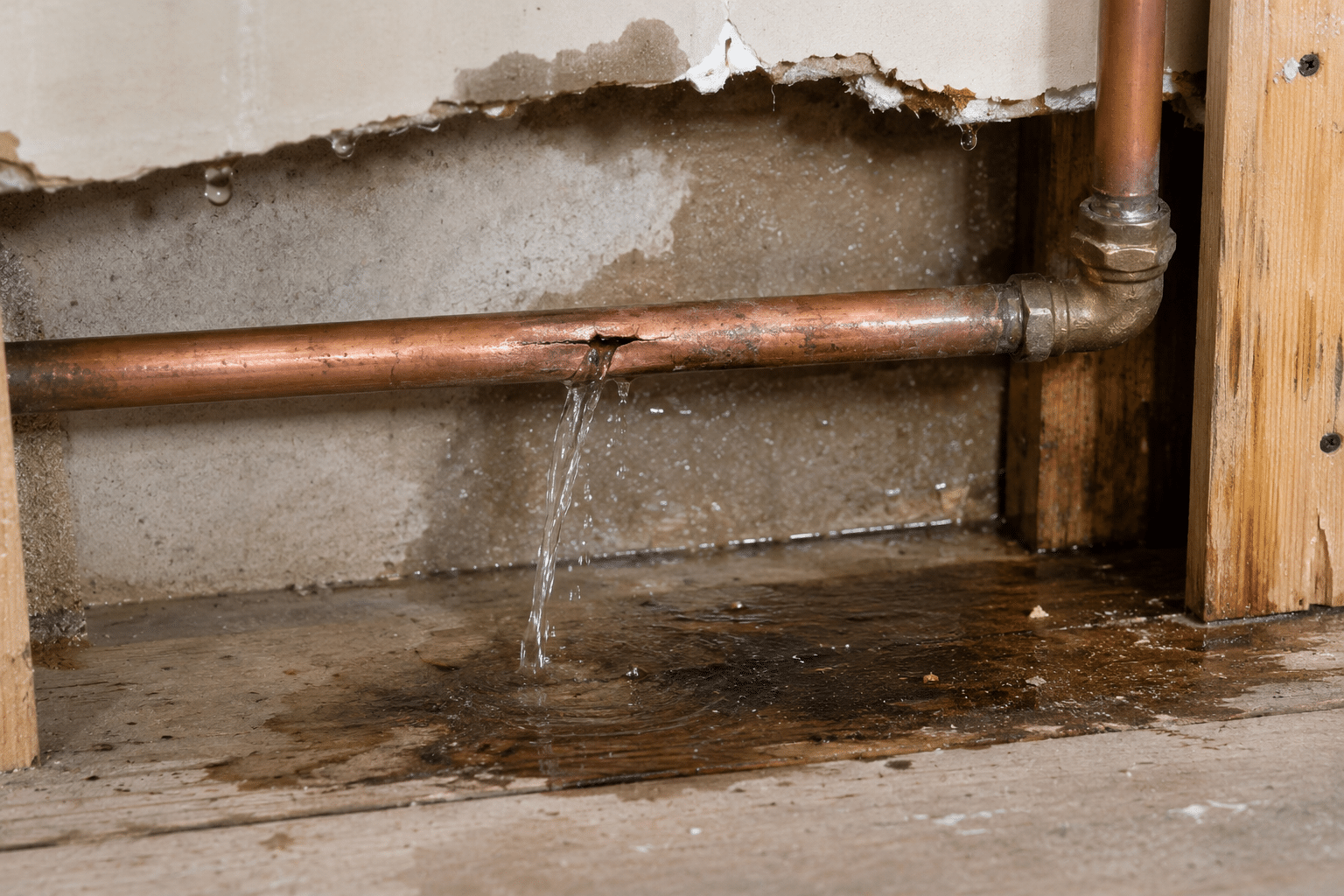
Not every leak comes from the pipe itself. In fact, the fittings that connect pipes to taps, toilets and appliances fail more often.
Compression joints rely on a small brass ring called an olive. When the olive is damaged or overtightened, the joint weeps. We fit a new olive and nut rather than winding the old one tighter.
Isolation valves often leak from the spindle after years without use. We replace them with modern quarter-turn valves.
Flexi hoses have a limited life, and a split hose can release water as fast as a burst pipe. If yours are rusty, kinked or bulging, we recommend replacing them before they fail.
Together, these small parts cause a large share of the leak calls we get from kitchens and bathrooms.
Hidden Leaks Behind Walls, Floors and Ceilings
Water follows the path of least resistance. It runs along pipes, joists and cables before it finally shows as a stain, which means the wet patch is often a metre or more from the leak.
We start with the simple clues: which rooms are affected, whether the leak changes when a particular tap runs, and where pipes are likely to route. A thermal camera can also help, since warm pipes show up clearly through plaster and flooring.
Sometimes, reaching the leak means lifting a floorboard, opening a panel or cutting a small hole in plasterboard. We always explain what access we need and agree it with you first. We keep openings as small as possible, although making good plaster or tiles afterwards is a job for a decorator.
Please note that we don't offer tracer-gas or acoustic leak detection.
Hidden leaks often come to light during a repair, because water shows up in one room while the fault sits in another. Patience at the tracing stage saves opening up the wrong wall.
Burst Pipe Repair in Winter: Frozen Pipes
Irish winters are usually mild, but a few nights of hard frost are enough to split exposed pipes. Most freeze-related calls come from attics, garages, utility rooms in extensions and outside taps.
If a Pipe Has Frozen
Turn off the water at the stopcock first, because the pipe may already be split. Then warm it gently with warm towels or a hairdryer on a low setting, starting at the tap end. Never use a blowtorch or naked flame.
Preventing Frozen Pipes
- Lag pipes and tanks up in the roof space, but leave the area under the tank uninsulated, so warmth rises to it.
- Isolate and drain outside taps before winter.
- Leave the heating on a low setting during cold spells, even when you're away.
- Know where your stopcock is and check that it turns.
If frost does split a pipe, we can usually attend the same night.
Pipes in Attics, Hot Presses and Under Floors
Irish homes hide their pipework in a few familiar places, and each one brings its own challenges.
Attics. In many older houses, a storage tank sits up in the roof space and pipes cross the joists to reach it. These pipes face frost and are easy to knock. Leaks here often show up first as a ceiling stain on the landing.
Hot presses. Valves and a tangle of pipes share a small cupboard. Heat and pressure changes loosen joints over time, so a damp hot press floor deserves attention.
Suspended timber floors. In older houses, pipes run between joists under the floorboards. Lifting one or two boards usually gives good access.
Solid floors. In many newer homes, pipes sit under concrete screed. Breaking up a floor is disruptive, so we often suggest rerouting the pipe along a wall instead.
Wherever the pipe runs, knowing its route speeds up any future burst pipe repair. We're happy to point out the key valves and pipe runs before we leave, so you know where to look next time.
Repair or Replace the Pipe Run?
A single failure in otherwise sound pipe calls for a local repair. Nevertheless, several warning signs suggest that a longer replacement makes more sense:
- repeated pinhole leaks in the same run
- green or white crust on several joints
- pipes that flex or bang because they were never clipped properly
- a mix of materials joined with makeshift fittings
- pipe buried in a floor where the next leak would be hard to reach
In those cases, we can install a new pipe run along a more accessible route, often surface-mounted and neatly clipped, or boxed in if you prefer. We explain both options and the likely cost of each before any work starts, so you can decide.
Replacing a problem section in one go avoids repeated call-outs and repeated damage. It's also far easier to arrange as planned work than during a night emergency.
Landlords and management companies often book this kind of upgrade between tenancies. For them, a planned replacement means one bill instead of a series of emergency visits.
Burst Pipe Repair Dublin for Apartments and Landlords
Leaks in apartments rarely stay in one unit. Water finds its way down through ceilings, light fittings and service risers into the homes below.
Residents. When water drips from above, knock on the upstairs door or ring the managing agent at once, since the shut-off could be inside that flat or in a communal cupboard.
Landlords and letting agents. We attend on your behalf, arrange access with the tenant and send you a short update once the leak is fixed.
Management companies. We can work on shared risers and plant rooms, isolating a single stack rather than the whole building. For planned work, we agree timings in advance, so residents get notice of any water shut-off.
Every repair we complete in an apartment block includes a check of the unit below, because hidden water can keep dripping long after the leak stops.
Commercial Burst Pipe Repair in Dublin
A burst pipe can close a kitchen, a bar or a hotel corridor within minutes. Our commercial customers range from hotel groups and B&Bs to busy bars, restaurant kitchens, forecourt shops and office blocks.
Industrial sites need a steady water supply too. In factories, warehouses and workshops, leaks in welfare areas, canteens and process supplies can halt a shift. We work around production wherever possible and can attend during night shifts.
Before we arrive, tell us where the leak is, which areas are open to the public or staff, and who can let us into plant rooms or ceiling voids. Companies can settle by card, cash or transfer to our bank account.
Where a building has repeated leaks, we can also give an estimate for replacing problem pipework as planned work outside trading hours.
Many businesses keep our number with their emergency contacts, so staff know who to call when a pipe bursts, even when the manager isn't on site.
Insurance and Water Damage
Water damage is one of the most common home insurance claims in Ireland. A few simple steps make the process smoother:
- Photograph the leak, the wet areas and any damaged belongings before you move them.
- Contact your insurer early, as many policies have a claims helpline that runs day and night.
- Keep receipts for emergency costs, including the plumber's invoice.
- Ask us for a written report describing the fault and the repair.
On request, our report explains what failed, why it failed where that's clear, and what we replaced. Insurers and loss adjusters usually find this helpful when assessing a claim.
Drying out, plastering and redecorating are separate trades. However, we can tell you when the plumbing side is complete, so the drying process can begin.
Keep the failed fitting or section of pipe if your insurer asks for it. It can help a loss adjuster confirm the cause, and it costs nothing to put it in a bag.
Burst Pipe Repair Dublin FAQs
How long does a burst pipe repair take?
Most straightforward repairs take between one and two hours once we arrive. Hidden leaks and awkward access can take longer, and we'll tell you if that's likely.
Can I use tape or a clamp until you arrive?
A repair clamp or self-amalgamating tape can slow a small leak for a short time. However, turning off the water is far more effective, and neither should stay in place as a permanent fix.
Will I have water after the repair?
Yes. We restore the supply as soon as the repair passes our pressure test. In most cases, you only lose water to the affected section while we work.
What if water has reached sockets or lights?
Stay out of the wet area. Cut the power at the consumer unit, but only from dry ground. If in doubt, leave it alone, and call an electrician as well as us.
Do you repair leaks on outside taps?
Yes. We repair and replace outside taps and the pipe feeding them, and we can fit an internal isolation valve, so you can drain the tap before winter.
Leak and Pipe Repair Questions
Why does the leak only appear when I use the shower?
That usually points to the waste side rather than the supply, or to a joint that only takes pressure when the shower runs. We test each part separately to find the source.
Is a small drip worth fixing straight away?
Yes. Even a slow drip can rot timber, stain ceilings and encourage mould over time. Booking a daytime visit for a drip costs much less than an emergency later.
Can you fix a leak behind a washing machine or dishwasher?
Yes. Appliance valves and hoses fail regularly. We replace the faulty part, reconnect the appliance and check the joint while it fills.
Do you work on pipes under concrete floors?
We can, although rerouting the pipe along a wall is often quicker, cheaper and easier to maintain. We'll explain both options.
Is your work covered by insurance?
It is. Full insurance cover applies to all our pipe work, whatever the size of the job.
Prices, Booking and Payment
Our rates depend on when we attend. Weekday office hours carry the standard rate, while after-hours, weekend and holiday visits are charged at a higher rate.
Our hourly rates are listed on our Prices page, and we send you the applicable rate by text or WhatsApp, where possible before we set off.
Private customers settle up by cash, card or a secure link we text over when the job is done. Business accounts may pay by transfer.
For non-urgent leaks, send us a photo first. It helps us bring the right fittings and plan the job during cheaper daytime hours. For an active burst, just ring straight away.
Whether it's a planned repair or an urgent call, the hourly rate is confirmed before the work starts.
See our 24 hour plumber page for night call-outs, or our plumbing services page for other work. Our Dublin service area page lists the areas we cover.
Call for a Burst Pipe Repair in Dublin
Water escaping right now? Turn off the nearest valve or the stopcock, keep clear of anything electrical and ring us. Tell us your Eircode and where you can see water.
For supply outages or low pressure across your street, check Uisce Éireann first. For anything inside your property, we're here to help.